

Key catalysts for markets in the weeks ahead
Review the latest Weekly Headings by CIO Larry Adam.
Key takeaways:
- The Fed is expected to hold rates steady at next week’s FOMC meeting
- Busiest week of S&P 500 earnings on deck, with hyperscalers in focus
- Democrats hold polling advantage heading into the midterm elections
The next two weeks bring an unusually crowded lineup of potential market-moving catalysts, including a Federal Reserve (Fed) policy meeting, the busiest stretch of third-quarter 2026 earnings season, the Treasury’s Quarterly Refunding Announcement and the midterm elections. Together, these events could shape expectations for economic growth, earnings, interest rates and Fed policy in the weeks and months ahead. Below, we highlight the key developments we’re watching and why they matter for financial markets.
Fed policy outlook
Despite hotter-than-expected inflation data, markets are pricing just a 10% probability of a rate hike, down from approximately 70% following last month’s hike, heading into next Wednesday’s Federal Open Market Committee (FOMC) meeting. While recent remarks from Fed officials Williams and Jefferson suggest little urgency to tighten further, solid economic momentum (consensus expects 3Q GDP to accelerate to a 3.0% seasonally adjusted annualized rate) and broadening price pressures could complicate an October pause.
Under the previous Fed, odds this low would have made a decision-day surprise unlikely. But with inflation above the Fed’s 2.0% target for more than five years and several policymakers signaling further tightening may be needed, the October meeting could be more live under the Warsh-led Fed than market pricing implies. Assuming no change in policy, the post-meeting press conference will likely be brief. Our base case remains one additional hike in December, followed by a prolonged pause. Still, a hawkish dissent in October would not be surprising: Four FOMC members penciled in two additional hikes by year-end in the September dot plot, while persistent inflation and oil at approximately $100 per barrel keep risks tilted hawkish.
Major tech-related earnings
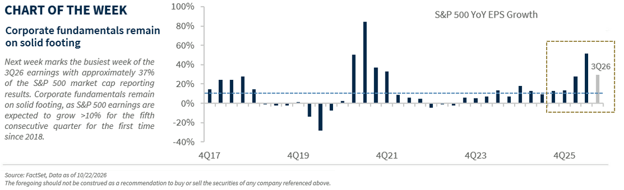
Next week marks the busiest week of 3Q26 earnings season, with 172 companies representing 37% of the S&P 500 market cap reporting. While still early, third-quarter results are off to a strong start, with S&P 500 earnings up approximately 29% year over year, marking the fifth consecutive quarter of double-digit earnings per share (EPS) growth, the longest streak since 2018.
Meanwhile, 82% of companies are beating EPS estimates, above the previous 10-year average of 77%. The spotlight now shifts to the three largest hyperscalers, Alphabet, Amazon and Microsoft, as investors assess whether AI monetization can keep pace with rapid investment, with cloud revenue, capex guidance and free cash flow in focus. With hyperscaler AI infrastructure spending expected to surpass $1 trillion in 2027, strong results and guidance will be critical to sustaining confidence in the AI ecosystem amid elevated expectations and growing financing concerns. The results will also test the earnings growth underpinning our 8,450 12-month S&P 500 target.
Beyond tech, Visa, Mastercard, Hilton and Starbucks will offer a read on consumer resilience, while UPS and FedEx should provide a real-time pulse on broader economic activity.
Treasury bond supply
The November 4 Quarterly Refunding Announcement could be an important catalyst for rates as the Treasury Department updates its long-end liquidity buyback program and upcoming borrowing needs. While the Treasury remains committed to “regular and predictable issuance,” recent market chatter suggests it could trim longer-maturity issuance and potentially eliminate new 20-year bonds, which were reintroduced in 2020.
Less long-end supply could temporarily support bond prices and lower yields, but it would not reduce overall government borrowing needs. Instead, issuance would shift to bills or other shorter maturities, potentially increasing refinancing risk. While supply can influence short-term yield movements, economic growth and inflation remain the more durable forces shaping the rate outlook.
Midterm elections
With less than two weeks left before the midterm elections, early voting results point to strong enthusiasm for Democrats. That is not entirely surprising, as the party not in power typically picks up seats in the House and Senate during the midterm elections, particularly when the president’s approval rating is low. And with President Trump’s approval rating near a record low of 39%, Democrats are in a solid position to at least regain control of the House.
Polling suggests Democrats have the advantage amid broad voter dissatisfaction with the economy and ongoing affordability issues. As a result, our Washington Policy team sees Democrats well positioned to win the House, while Senate control remains a toss-up, leaving a Democratic sweep as the most likely scenario. Regardless of the outcome, the S&P 500 has historically performed well after the midterms. In fact, the index has gained approximately 15% on average in the 12 months following the midterms and was positive 100% of the time dating back to 1942.
All expressions of opinion reflect the judgment of the author(s) and the Investment Strategy Committee and are subject to change. This information should not be construed as a recommendation. The foregoing content is subject to change at any time without notice. Content provided herein is for informational purposes only. There is no guarantee that these statements, opinions or forecasts provided herein will prove to be correct. Past performance is not a guarantee of future results. Indices and peer groups are not available for direct investment. Any investor who attempts to mimic the performance of an index or peer group would incur fees and expenses that would reduce returns. No investment strategy can guarantee success.
Economic and market conditions are subject to change. Investing involves risks including the possible loss of capital.
The information has been obtained from sources considered to be reliable, but we do not guarantee that the foregoing material is accurate or complete. Diversification and asset allocation do not ensure a profit or protect against a loss.
The S&P 500 Total Return Index: The index is widely regarded as the best single gauge of large-cap U.S. equities. There is over USD 7.8 trillion benchmarked to the index, with index assets comprising approximately USD 2.2 trillion of this total. The index includes 500 leading companies and captures approximately 80% coverage of available market capitalization.
Sector investments are companies focused on a specific economic sector and are presented here for illustrative purposes only. Sectors, including technology, are subject to varying levels of competition, economic sensitivity, and political and regulatory risks. Investing in any individual sector involves limited diversification.
